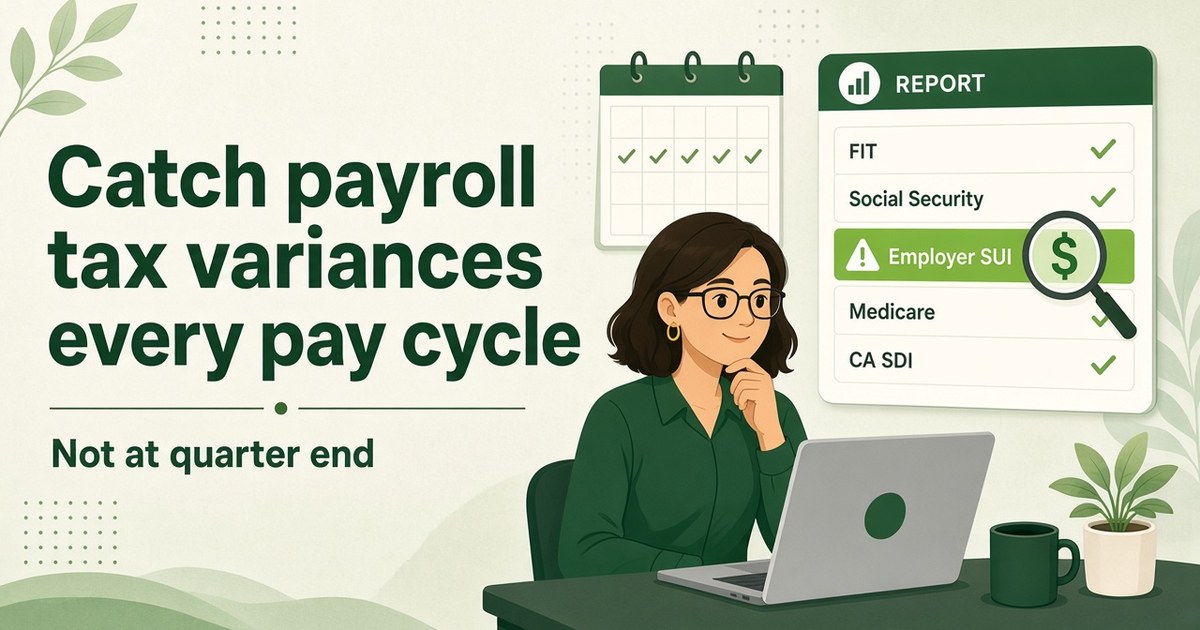
A payroll tax variance is the gap between the tax payroll withheld and the tax that should have been withheld. The fix is to check for it every pay cycle, not at quarter end.
Think of it like a grocery receipt. Catch a wrong price at the register and it's fixed on the spot. Find it on your card statement a month later and you're digging for the receipt and calling the store.
Quarter end is the card statement. Every pay cycle is the register.
What causes payroll tax variances
Most come from payroll setup, not math:
- An out-of-date state unemployment tax (SUI) rate
- The wrong work state or address for an employee
- The wrong wages counted for a tax (each tax applies to a specific set of wages)
Why payroll tax variances are a problem at quarter end
The error repeats. One bad setting hits every payroll after it, so a small gap in August is a bigger one by September.
Someone rebuilds it against a deadline. At quarter end, whoever owns tax is pulling months of employee detail back apart, with filings due. And what's owed keeps moving after the quarter closes, too (more on that here).
Totals don't show where. Totals tell you something is off. They don't tell you where. That's the card statement: one number, no items.
For a bureau or PEO, it multiplies. The same problem plays out across every client and every EIN you file for.
Payroll came up $220.50 short on state unemployment tax for one pay period because it used a lower rate than the 3.40% on file. Catch it on that payroll and it's one fix. Miss it until quarter end and it's every payroll since.
Illustrative figures from the example on our daily variance page: one California client, one pay period. Not a customer case.
One blind spot: if payroll and your tax platform have the same wrong rate, there's no variance to find. Both sides agree, and both are wrong. That's why each new SUI rate notice, including the 2027 notices, needs its own check against what's printed on it.
How Tax Pilot checks payroll tax variances every pay cycle
If you run payroll tax for a lot of clients with a small team, you want to find a gap before the client or the agency does. So we check at the register. Daily checking means checking each payroll as it runs:
- Payroll comes in over an API, at the employee level. Summary files don't carry enough detail to show which employee is off.
- Each tax is recalculated and compared. We take the wages each tax applies to and the rate on file, then compare that with what payroll withheld. Gaps show up by tax, with the employees behind them. (In the example on our site, that covers taxes with a set rate, like SUI and Social Security. Income tax withholding isn't recalculated there.)
- You decide how it's settled. If payroll's number is simply off, approving it adds an offset (an adjustment so the agency still gets paid the full amount). If the cause is setup, the fix goes to whoever owns payroll setup, with the detail attached. An offset settles this payroll. A source fix settles the next one.
- Quarter end becomes a check. With gaps settled every pay cycle, the quarter's wage report is usually clean by the time it needs approval. Quarter end becomes verification, not a rebuild.
Variance checking doesn't replace reconciliation. Settled variances still have to match the bank:
| Control | Question it answers |
|---|---|
| Payroll tax variance checking | Did payroll withhold the right tax? |
| Reconciliation | Do the bank, the payroll tax ledger, and what's owed all agree? |
Our reconciliation overview covers that one.
Common questions
What is a payroll tax variance? It's the gap between the tax payroll withheld and the tax that should have been withheld, figured for each tax.
What causes a payroll tax variance? Usually payroll setup, not math: an out-of-date SUI rate, the wrong work state or address, or the wrong wages counted for a tax.
How often should payroll tax variances be checked? Every pay cycle. Checking each payroll as it runs catches a gap while the cause is still easy to trace.
Can you check payroll tax variances from totals alone? No. Totals can show that something is off, but you need employee-level wages and taxes to see where.
Is payroll tax variance checking the same as reconciliation? No. Variance checking compares the tax that should have been withheld with what payroll withheld, while reconciliation ties the bank, the ledger, and what's owed to agencies. See Payroll Tax Reconciliation: Why the Numbers Don't Match.
Run it yourself: see how it works on the daily variance overview.
Want a hand: if you've got a backlog of open variances, talk with Tax Pilot Advisory. We work alongside your team, not in place of it.