
The quarter ends March 31. The returns go out April 30. By that point, most payroll teams believe the number is settled: the liability is what it is, the filings are done, and attention turns to Q2.
It's not settled. Not even close.
For roughly 89 days after a quarter closes, your payroll tax liability is a moving number. State deposits take weeks to post. Amendments come in from both sides. Agency-initiated adjustments change the picture without notification. SUI rate corrections applied mid-year affect prior-quarter calculations retroactively. What shows in your GL as a closed, reconciled quarter is an estimate that keeps changing until well into the following quarter.
Most payroll teams already know this. The problem is the tools they have to manage it.
Why the Number Keeps Moving After Quarter-Close
Three independent systems hold pieces of the liability picture, and none of them update in sync.
The bank records payments as they clear. The GL records accruals and payments as they're entered. The tax liability system records filings and payments as they're submitted. For the number to be accurate, all three have to agree, and they don't, continuously, for the entire window between when a quarter closes and when the last state finishes processing what was filed.
State deposit posting is the most common lag. A payment submitted April 15 may not appear in the state account portal until late April or early May. Your bank cleared it. Your GL shows it. The state shows nothing. Until it posts, you're carrying a liability the system thinks is unpaid. Multiply that across 15,000+ jurisdictions with different posting timelines, and the picture stays blurry for months.
Amendments compound the problem. An agency recalculates a rate. A classification changes retroactively. A prior-quarter return gets corrected. Each adjustment shifts the settled number further from what the original filing showed. These don't announce themselves: they show up as discrepancies at the next reconciliation point, which for most teams is quarter-end.
What Quarter-End Reconciliation Actually Shows You
The quarter-end scramble produces a snapshot of the liability at a single moment in time, reconciled against two other systems that have been running independently for 90 days.
The snapshot is better than nothing. It catches variances that accumulated during the quarter and surfaces them before they roll into the next one. But it has a structural problem: by the time the team runs the reconciliation, some of those variances are 89 days old. The further back an error goes before it's caught, the harder it is to unwind and the more it costs to fix.
"Quarter-end fire drill" is how one payroll director described it. The same team processing current payroll is also trying to reconstruct three months of activity to understand why the number doesn't match. They find the discrepancy, resolve it, and move on, until it happens again in 90 days.
What a Continuous Visibility Model Actually Requires
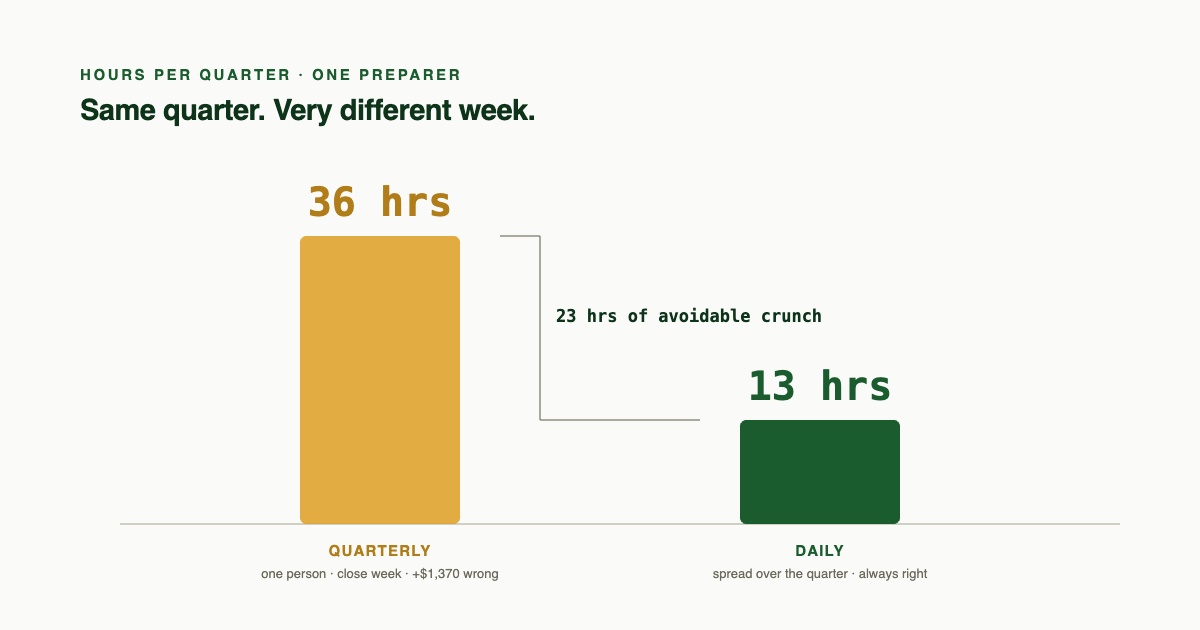
The alternative isn't a different reconciliation process at quarter-end. It's running the reconciliation daily instead of quarterly.
A daily three-way comparison, what cleared the bank, what the GL recorded, and what the tax liability system shows, catches variances when they're hours old, not months old. A payment that clears but doesn't post to a state account becomes visible the next day, not at quarter-end. An amendment that shifts the liability number gets flagged immediately. The 89-day window of accumulated uncertainty collapses into a 24-hour window of known variance.
Running this daily requires two things most teams don't have: a system that pulls from all three sources automatically, and a process that makes acting on variances faster than ignoring them. Manual daily reconciliation across multiple FEINs and dozens of states isn't feasible for most teams. The capacity isn't there, and the tools aren't built for it.
What Changes When the Window Closes Daily
Quarter-end stops being an investigation. When variances surface daily, they get resolved the same week they appear rather than reconstructed weeks later. What's left at quarter-end is confirmation that the daily process caught everything, not discovery of everything that went wrong since the last look.
The liability number in the GL reflects what's actually owed, not what was owed 89 days ago. State account balances tie to what was filed and paid, continuously, rather than at a single reconciliation point. Amendments and agency adjustments get absorbed into the current picture as they arrive rather than piling up for the next sprint.
The IRS and state agencies don't grade on a curve for teams that only look quarterly. "It's a matter of when, not if it results in fees and penalties" is how one enterprise payroll leader described their exposure heading into year-end with unresolved variances still sitting in the books from Q2.
Tax Pilot is built around this model. The daily reconciliation runs automatically: bank, GL, and tax liability compared every day across every jurisdiction and FEIN. Variances surface as they appear rather than 89 days later. For teams carrying an existing backlog of open variances, Tax Pilot Advisory runs the cross-system audit, clears the outstanding items at the agency level, and establishes the continuous monitoring process while the longer-term infrastructure question gets worked out.
Building an in-house payroll system, or running on legacy tax software? Tax Pilot is a purpose-built payroll tax compliance platform. API-first, daily reconciliation, every state. Currently in beta with select customers. Request a demo →
Need expert hands to run the reconciliation while you get the infrastructure right? Tax Pilot Advisory becomes your outsourced payroll tax compliance team. We run the cross-system audit, clear the open variances, and manage ongoing reconciliation inside your existing systems. See how Tax Pilot Advisory works →