
MasterTax comes with an implementation project. That project ends. The work doesn't.
The assumption when buying enterprise payroll tax software is that configuration is a one-time event: get it set up, validate the outputs, hand it to the team running payroll. That assumption shapes every MasterTax implementation budget. It rarely matches the reality of what running the system well actually requires.
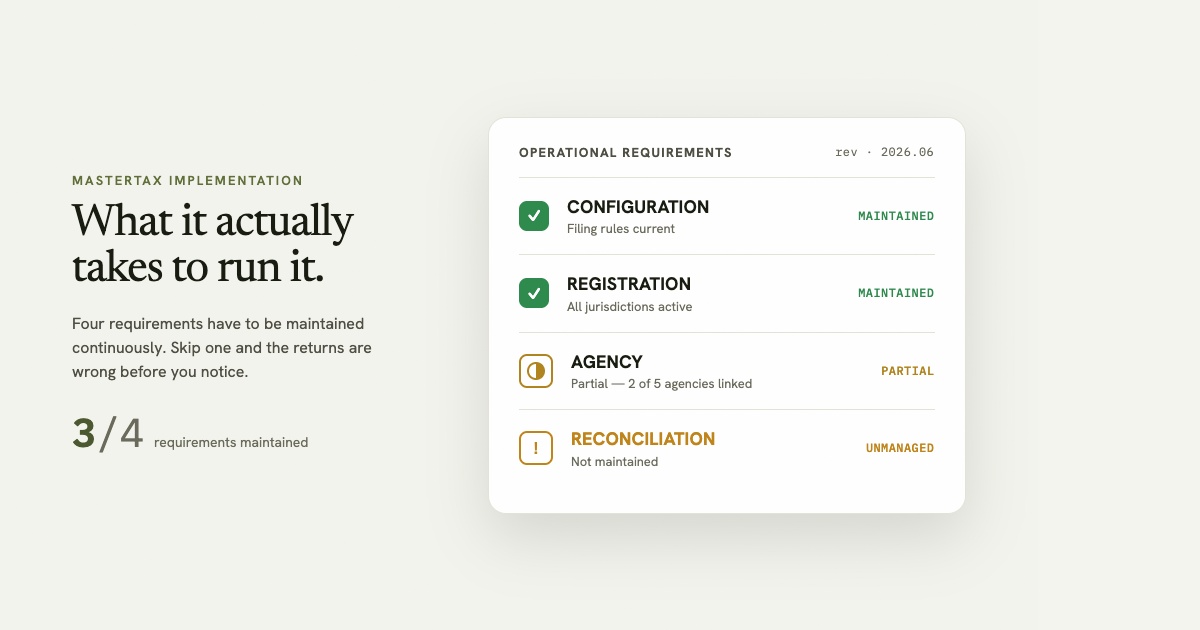
Running MasterTax correctly requires active, ongoing ownership across four operational areas. Most teams carrying a MasterTax license don't have the capacity or expertise to cover all four. What looks like a solved problem at go-live becomes a quietly accumulating liability twelve months later.
Configuration Requires Continuous Maintenance
MasterTax is only as accurate as the data it's been given, and that data ages faster than most implementation projects account for.
State and local wage bases change every January. Withholding rates update at various points through the year with no centralized notification. New local jurisdictions emerge; existing ones change filing frequencies, merge, dissolve, or move to online-only submission. Every change has to be reflected in MasterTax before the next payroll run touching the affected jurisdiction. If it isn't, the system calculates and files using outdated parameters, and the variance between what was filed and what was owed compounds with each passing pay cycle.
Rate and wage base maintenance isn't a quarterly cleanup task. At scale, it's a continuous workflow: monitoring jurisdiction changes, validating updates against the official source, applying them to the correct tables, and confirming they calculate correctly before they affect live payroll. Teams that handle this well have someone whose job description includes it. Most teams have someone who does it when they have time.
The Registration Posture Has to Stay Current
Beyond rate maintenance, MasterTax requires an accurate, complete picture of where the company has filing obligations. That picture changes constantly.
Every new hire in a new state, every remote employee moving between states, every new satellite office or acquired entity adds to the registration footprint. MasterTax files what it's configured to file. If a jurisdiction isn't in the system, MasterTax isn't filing there, and it generates no alert for a jurisdiction it doesn't know about.
Keeping the registration posture current requires a process that runs alongside HR and the business: monitoring workforce changes, understanding which events trigger new filing obligations, and updating MasterTax before the first affected payroll runs. That's a coordination function, not a configuration function, and it requires payroll tax knowledge that lives separately from system administration.
Agency Accounts Need Active Management
Even a properly configured MasterTax implementation doesn't manage the state accounts it files to. That's a separate layer of work most teams underestimate.
Each agency account has credentials, an authorized signer, a designated correspondence address, and a filing portal. Those details have to be current or the payroll system and the agency fall out of sync. An authorized signer who left two years ago, an email address routing to a former employee, a portal login that was never set up properly: all of these produce compliance exposure that exists entirely outside of MasterTax.
Agency account management also means monitoring what states are actually sending. Correspondence that goes unread, a notice that arrives at the wrong address, a rate-change confirmation that never gets imported back into the system: MasterTax doesn't know about any of it unless someone reads the mail and closes the loop.
Reconciliation Is an Active Process, Not a Report
MasterTax produces liability reports. Reconciliation requires taking those reports and comparing them against two other systems MasterTax doesn't touch: the bank and the general ledger.
The proper standard is a three-way comparison: what cleared the bank, what the GL recorded, and what MasterTax shows as the liability. When those three numbers tie, the compliance picture is clean. When they don't, the variance needs investigation before it compounds. Most MasterTax users run this comparison quarterly, which is why quarter-end tends to surface surprises that have been building for months.
Year-end W-2 reconciliation adds another layer: validating that the aggregate of four quarters of state filings matches W-2 totals by state. Where they diverge, the investigation traces back through MasterTax's transaction history to find where the divergence started. That's skilled work that requires both MasterTax proficiency and payroll tax knowledge, alongside the IRS Publication 15 baseline for federal employer obligations.
The Expertise a Proper MasterTax Implementation Requires
These four operational areas require a specific profile: someone with deep MasterTax system knowledge, active awareness of multi-state payroll tax requirements, established agency relationships, and the capacity to run maintenance and monitoring as a continuous workflow rather than a periodic project.
That's a full-time function at most companies running MasterTax at scale. It's rarely budgeted as one. The more common model: a payroll specialist who also manages MasterTax, alongside processing current payroll, handling employee inquiries, and supporting year-end. When something falls through the gap, it's usually not negligence. It's capacity.
Tax Pilot Advisory steps in as that dedicated MasterTax operation. Configuration maintenance, jurisdiction registration, agency account management, and reconciliation discipline: Advisory covers the full operational stack, working inside your existing MasterTax instance to keep it current and accurate rather than replacing it. For teams running MasterTax without the in-house expertise to maintain it properly, Advisory closes the gap between what the software is capable of producing and what it's actually producing right now.
Running MasterTax without the in-house expertise to keep it current? Tax Pilot Advisory becomes your outsourced MasterTax expert. We handle the configuration, jurisdiction maintenance, and notice management so your team isn't filing blind between quarters. See how Tax Pilot Advisory works →
Building an in-house payroll system, or running on legacy tax software? Tax Pilot is a purpose-built payroll tax compliance platform replacing legacy tools like MasterTax. API-first, daily reconciliation, every state. Currently in beta with select customers. Request a demo →