
Most enterprise software categories have a managed version. Managed IT. Managed security. Managed cloud infrastructure. The pattern is consistent: a platform that requires continuous expert attention gets a corresponding service layer for companies that can't or don't want to build that expertise internally.
Payroll tax compliance is catching up. MasterTax is the dominant enterprise platform, and the operational requirements for running it well are significant enough that a managed model is emerging as a legitimate alternative to building an in-house function. This is what that model looks like.
Why MasterTax Creates a Managed Services Problem
MasterTax is a calculation and filing engine. It produces correct outputs when it receives correct inputs, and it requires a specific set of ongoing operational inputs to stay accurate: rate and wage base updates, registration maintenance, agency account management, and reconciliation discipline applied consistently across every jurisdiction where the company has employees.
Those inputs don't come from the software. They come from the team running it. And the team required to run it well is a specialized function: deep platform knowledge, active multi-state payroll tax expertise, agency relationship management, and the capacity to handle all of it continuously rather than in quarterly bursts.
Most companies that need MasterTax don't have that team. They have a payroll specialist, or a shared services function, or a corporate tax team that absorbed payroll tax when the specialist left. None of those are the same thing. The gap between what MasterTax requires to run correctly and what most teams can provide is where penalties accumulate and where the managed model starts to make sense.
What Managed MasterTax Means
Managed MasterTax isn't a licensing model or a software subscription. It's a service arrangement in which an external team takes ownership of the MasterTax operational function for a company.
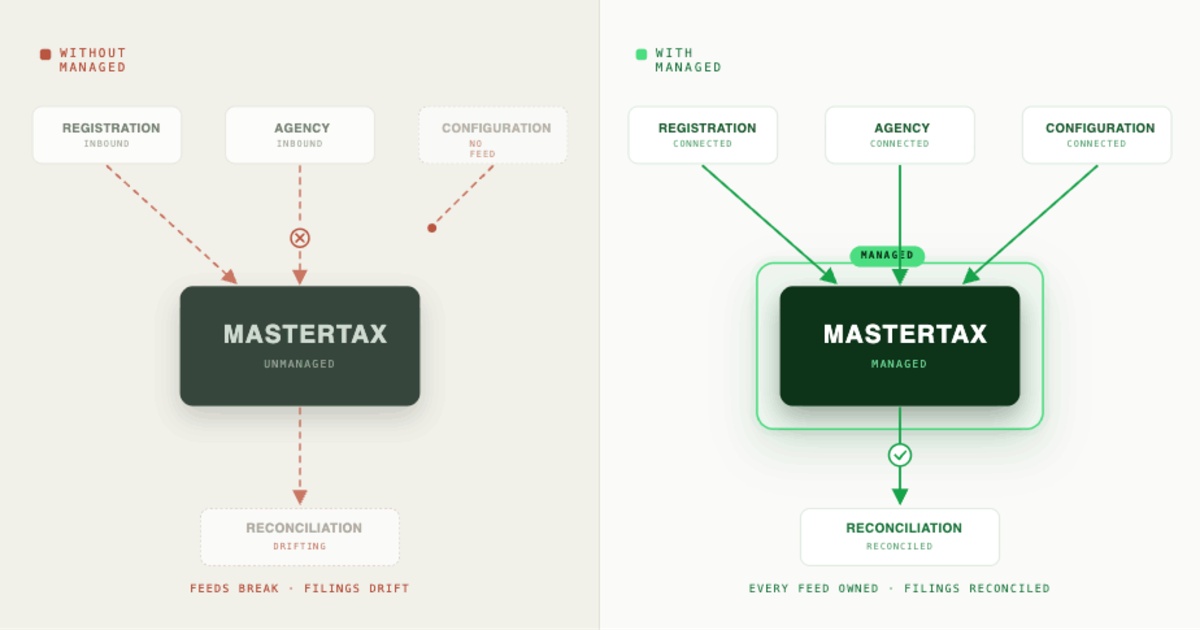
The distinction matters. A managed provider isn't advising on how to run MasterTax. They're running it: making the configuration changes, maintaining the registration posture, managing the agency accounts, closing the reconciliation loop. The client retains the MasterTax license. The managed provider becomes the operational team working inside it.
This is different from implementation consulting, which delivers a configured system and exits. It's different from a payroll bureau, which processes payroll using its own systems. Managed MasterTax is for companies that are keeping their MasterTax instance and want someone with the expertise to operate it correctly and continuously.
What a Managed Provider Owns
The scope of a managed MasterTax engagement covers six operational areas that MasterTax requires but doesn't self-manage.
Daily payment operations. The provider manages the full daily payment cycle: importing the payroll tax file from the client's payroll system into MasterTax, working any exceptions before the payment window closes, submitting payments via EFT credit and check across every active FEIN, and uploading the ACH file to the bank before end-of-day deadlines. Payment confirmation tracking, NSF management (placing holds, coordinating recovery, releasing payments once resolved), and deposit timing documentation are all part of this cadence. For companies running multiple FEINs across dozens of states, this work runs every business day.
Configuration and rate maintenance. The provider monitors jurisdiction changes, validates updates against official sources, and applies rate and wage base changes before they affect live payroll. This includes both state-level changes and sub-state jurisdictions, which update on irregular schedules with no centralized notification.
Registration posture. The provider tracks business changes (new hires in new states, entity additions, workforce moves) and updates the registration footprint in MasterTax before obligations are triggered. This requires coordination with HR and the business, not just system access.
Agency account management. The provider maintains current credentials, authorized signers, and correspondence routing for every state account. They monitor agency communications and close the loop between what states send and what MasterTax needs to reflect.
Reconciliation. The provider runs the three-way comparison between bank, GL, and MasterTax liability on a regular cadence, investigates variances before they compound, and manages the year-end W-2 reconciliation against state filing totals. The IRS Publication 15 baseline covers federal obligations; the state-by-state reconciliation work is where most of the managed provider's time goes.
Entity lifecycle management. The provider owns the compliance work at both ends of the entity lifecycle. When a company expands into a new jurisdiction or adds an entity, the provider handles tax account registration with each agency, EFTPS PIN applications, and MasterTax configuration before the first payroll runs there. When an entity is terminated, the provider manages the final returns, reconciles collected versus paid, coordinates any refunds or collections with the agencies, and handles account closure. These are the transitions that produce the most exposure when they go unmanaged, and the ones most likely to fall through the gap when compliance responsibility is split across teams.
How It Differs from a Bureau or Outside Consultant
A payroll bureau handles payroll processing. It runs the calculations, produces the paychecks, and files what it's been set up to file. It owns the processing infrastructure. Managed MasterTax is the opposite arrangement: the client owns the platform, and the provider owns the operation of it.
An outside consultant engages for a defined scope: an audit, a cleanup project, a configuration review. The engagement ends. Managed MasterTax is an ongoing operational relationship, not a project. The provider is accountable for the accuracy of the MasterTax instance week over week, not just at the conclusion of an engagement.
The distinction matters for how accountability works. A bureau can say it filed correctly based on what it was given. A consultant delivers a report. A managed MasterTax provider owns the outcome: the configuration is current, the filings are accurate, the variances are resolved.
What Good Looks Like
A managed MasterTax arrangement works when the provider has genuine depth in both the platform and multi-state payroll tax compliance. Platform knowledge alone isn't sufficient: someone who can configure MasterTax isn't necessarily equipped to resolve a Pennsylvania EIT discrepancy or navigate a state account reinstatement after an authorized signer has left. The combination of system expertise and payroll tax knowledge is what separates the model from a standard managed IT relationship.
The arrangement should also include notice management. Agencies issue notices. A managed provider that owns the operational function should be tracking, responding to, and resolving notices as part of the engagement, not routing them back to the client to handle. When notice response isn't included, the compliance loop doesn't close.
For companies carrying configuration debt, open variances, or a notice backlog from a period when the function went unmanaged, the engagement typically starts with a structured audit: establishing the actual state of the MasterTax instance before taking over the ongoing operation.
Tax Pilot Advisory provides managed MasterTax operations for enterprise teams running the platform without the in-house expertise to maintain it. The engagement covers configuration, registration, agency management, reconciliation, and notice resolution, working inside the client's existing MasterTax instance.
Running MasterTax without the in-house expertise to keep it current? Tax Pilot Advisory becomes your outsourced MasterTax expert. We handle the configuration, jurisdiction maintenance, and notice management so your team isn't filing blind between quarters. See how Tax Pilot Advisory works →
Building an in-house payroll system, or running on legacy tax software? Tax Pilot is a purpose-built payroll tax compliance platform replacing legacy tools like MasterTax. API-first, daily reconciliation, every state. Currently in beta with select customers. Request a demo →