
Every year, thousands of well-managed companies receive IRS notices for payroll tax penalties they didn't see coming. Not fly-by-night operations or cash businesses ducking their obligations, but companies with real compliance teams, real budgets, and a legitimate enterprise software solution in their tech stack. Many of them are running MasterTax.
The penalties still land. When a company buys MasterTax, it believes it has solved payroll tax compliance, and that belief is the problem. MasterTax is a powerful platform, but it requires dedicated ownership, continuous configuration, and deep in-house expertise to function as advertised. Most companies don't have that. So they buy the software, assume the problem is solved, and the penalty clock runs silently until a notice makes it visible.
The False Sense of Security MasterTax Creates
MasterTax is the dominant enterprise solution for payroll tax compliance. It appears on technology budgets as a significant line item, and that purchase carries an implicit promise: you've addressed the compliance problem. You haven't. You've licensed the capability to address it, which is a materially different thing.
The gap between "licensed the capability" and "actually compliant" is where penalties live, and for most companies running MasterTax, that gap is larger than anyone on the compliance team realizes.
What MasterTax Actually Requires to Work
MasterTax is a configuration-heavy platform. Its value is proportional to the expertise applied to it, and that expertise has to be applied continuously, not just at implementation.
Registration data must be current and complete. Every jurisdiction where you have filing obligations must be accurately loaded into the system. New states, new localities, new SUI account numbers: if they're not in MasterTax, MasterTax doesn't file there. It can't file where it doesn't know to look. When your company hires its first remote employee in Colorado or sets up a satellite office in Tennessee, someone has to update the system. If they don't, or if they don't know they need to, MasterTax keeps running quietly and filing nothing for those jurisdictions.
Tax tables require active maintenance. Rate changes, wage base updates, and new jurisdictional requirements don't automatically propagate into MasterTax. Someone with system access and subject matter expertise has to apply them. Most companies don't have a dedicated MasterTax administrator. They have someone who also does MasterTax, alongside three other things.
The system only surfaces what it's been configured to find. MasterTax won't flag a compliance gap it wasn't set up to detect. If your configuration is incomplete, your exception reports are incomplete. The absence of alerts is not evidence of compliance. It's evidence that the system isn't looking for what it doesn't know about.
The companies that use MasterTax well have dedicated tax operations teams with genuine MasterTax expertise and the processes to keep the system current as the business changes. That investment works.
The more common pattern: MasterTax gets purchased, goes through an initial configuration, and then ages. The business hires into new states. Jurisdictions update their rates. The implementation team turns over. Nobody on the current team has the depth to know what they don't know. The gap between what MasterTax thinks the company's obligations are and what those obligations actually are grows slowly and invisibly. "It's a matter of when, not if it results in fees and penalties" is how one enterprise payroll director described their exposure before the notices arrived. By then, the penalty calculation includes months of underpayment, interest, and sometimes failure-to-file charges. MasterTax was running the whole time.
The Ownership Gap MasterTax Can't Fix
Even a perfectly configured MasterTax implementation doesn't solve the structural problem sitting upstream of it.
Ask a CFO who owns payroll tax compliance and you'll get a confident answer. Ask the HR director and you'll get a different confident answer. Ask the payroll manager and you'll get a third one, usually accompanied by a reference to MasterTax. This is the ownership gap, and it exists independently of whatever software a company has licensed.
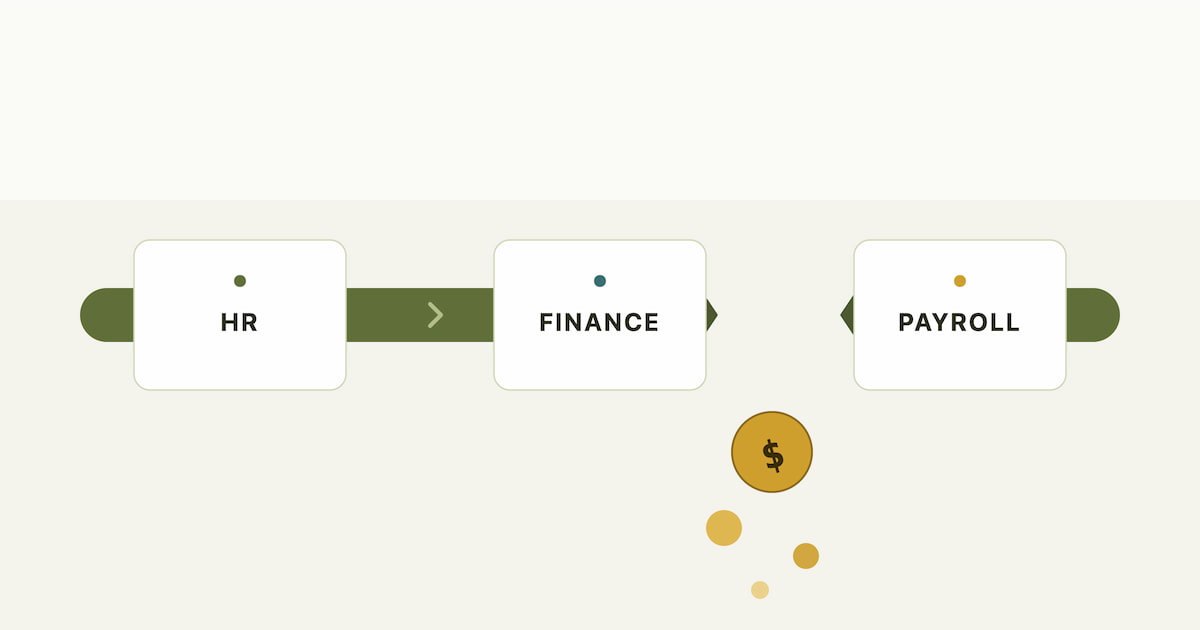
Payroll tax compliance sits at the intersection of three functions: HR, Finance, and Payroll. The handoff points between them are where penalties are born. HR owns employee data: new hires, terminations, withholding certificates, benefit elections that affect taxable wages. Finance owns the liability: accruals, payments, variance analysis. Payroll owns the mechanics: calculations, filings, feeding data into MasterTax. No single function has full visibility into the chain.
"The corporate tax team does not possess payroll knowledge" is how one enterprise payroll leader put it. Internal tax teams exist at most large companies, but they are income-tax people. Payroll tax is a distinct skill set: agency communication, registration management, notice resolution, multi-FEIN reconciliation. When the payroll specialist leaves and the corporate tax team absorbs the function by default, the gap doesn't announce itself immediately. It surfaces six months later in a notice pile nobody knew was building.
When a penalty notice arrives, the investigation usually reveals the same pattern: a status change in HR that wasn't reflected in Payroll, a filing deadline that Finance assumed Payroll was tracking, a jurisdictional registration nobody realized was required. MasterTax wasn't updated because nobody knew it needed to be; the information never made it from the function that had it to the function that needed it.
Each team did their job. Nobody owned the handoffs. MasterTax filed what it was told to file. The penalty is the price of the gap.
For single-state employers with stable headcount, this is manageable. For any company with multi-state exposure, remote employees, or meaningful workforce movement, it's a structural liability wearing the costume of a solved problem, and the solved-problem costume is often a MasterTax license.
Three Ways MasterTax Fails the Same Company
The ownership gap, configuration drift, and notice-resolution disconnect aren't independent problems. They form a system, and each one makes the others harder to detect.
The ownership gap means nobody has the cross-functional visibility to notice when MasterTax is getting stale. HR adds a state, nobody tells Payroll, nobody updates MasterTax. By the time the filing gap becomes a notice, the trail back to the original miss is months cold.
Configuration drift is the quiet accumulation of that staleness. Rate changes go unapplied. New jurisdictions get added to the payroll system but not to MasterTax. The implementation team turns over and the institutional knowledge of how the system was set up leaves with them. MasterTax keeps running, keeps filing, keeps generating a clean exception report. It's not configured to look for what it doesn't know about.
The notice-resolution disconnect is where the cycle compounds. A state sends a notice because the company has been filing under the wrong rate. The internal team responds to the state, documents it, and considers it handled. What doesn't happen: going back into MasterTax and correcting the rate that generated the notice. The next filing goes out the same way. Another notice arrives. Another response. MasterTax and the notice management workflow never talk to each other, so the loop runs indefinitely. Responding and resolving are different actions, and MasterTax handles the mechanics of filing without touching either.
Employers paid over $7 billion in IRS payroll tax penalties last year, and the number hasn't moved despite widespread MasterTax adoption across the enterprise market. The platform is more capable than ever. The compliance gap isn't closing because the gap was never inside the software.
Purpose-built payroll tax compliance tooling is being built to close that gap differently. For teams carrying the weight of a misconfigured MasterTax implementation in the meantime, Tax Pilot Advisory owns the MasterTax function for you: configuration, jurisdiction maintenance, and notice resolution, so the loop actually closes.
Running MasterTax without the in-house expertise to keep it current? Tax Pilot Advisory becomes your outsourced MasterTax expert. We handle the configuration, jurisdiction maintenance, and notice management so your team isn't filing blind between quarters. See how Tax Pilot Advisory works →
Building an in-house payroll system, or running on legacy tax software? Tax Pilot is a purpose-built payroll tax compliance platform replacing legacy tools like MasterTax. API-first, daily reconciliation, every state. Currently in beta with select customers. Request a demo →