
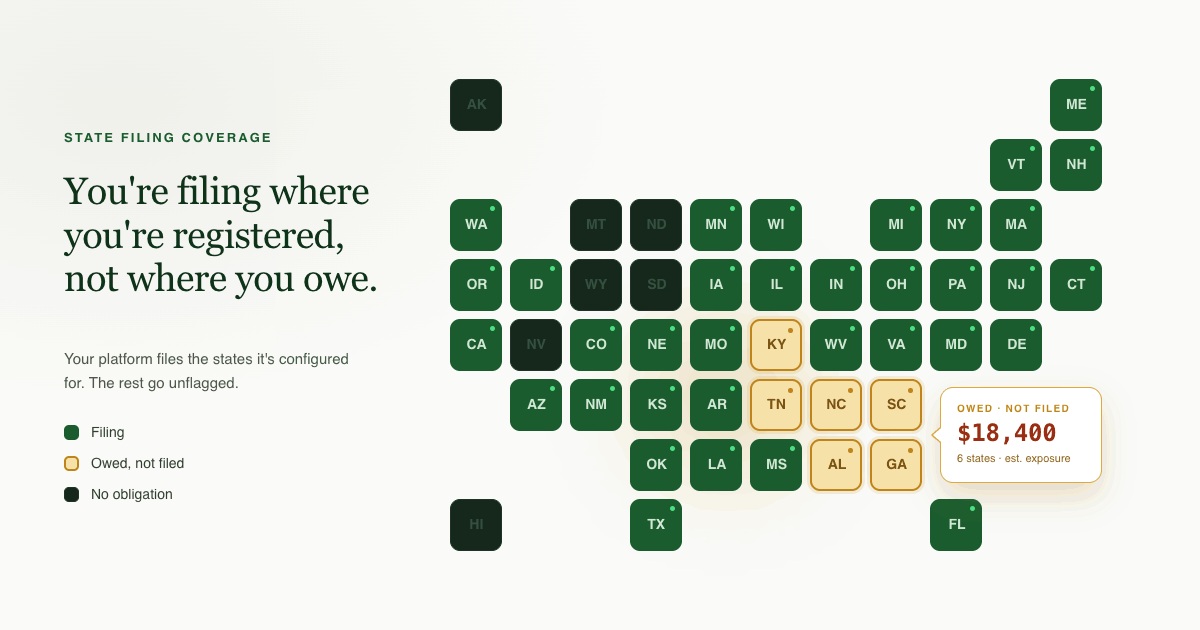
The IRS notice usually arrives before anyone realizes the platform wasn't filing. Not because a deadline was missed. Because the platform was set up to exclude that tax type entirely, and the configuration has been running quietly ever since.
ADP, Paylocity, Paycom, UKG, and every other major payroll platform share the same operating logic: they file what their implementation scope includes. A box unchecked during setup, a tax type classified as out of scope, a jurisdiction the platform marks as client responsibility. None of these generate alerts after the fact. They just don't file.
This is the filing gap problem, and it surfaces differently from most payroll tax exposure. There's no processing error to catch. The platform is functioning exactly as configured. The question is whether the configuration matches the company's actual obligations.
Why Payroll Platforms Miss Filings
Platform implementations are scoped. The implementation team configures what's in scope. What's out of scope doesn't get configured, and the platform has no mechanism to flag the gap later.
For companies using ADP's Smart Compliance, the experience often looks like this: a state notice arrives, the internal team submits it through the platform, and the response comes back noting that ADP is "not authorized to file in this jurisdiction" or that the filing is the client's responsibility. The notice is real. The obligation has been real. The platform just wasn't set up to cover it.
Federal 940 (FUTA) filings are among the most common exclusions. In multi-FEIN setups, the 940 scope often gets defined per entity at implementation, and a single missed checkbox means one FEIN goes without 940 filing for months or years before a notice arrives. The platform continues processing payroll, generating W-2s, filing state returns. The 940 doesn't go out.
The Filing Types Most Commonly Left Out
A payroll platform's default scope rarely matches a company's complete filing obligations. The gaps tend to cluster in the same places:
Federal 940. FUTA is filed annually but deposits run quarterly. In multi-FEIN environments, 940 scope is configured per entity and frequently missed during implementation for newly added entities or acquired companies.
Local jurisdictions. Most platforms handle state-level income tax and unemployment. Sub-state obligations are often treated as optional modules or client-managed filings: city wage taxes, county taxes, school district EIT and LST, and transit taxes. Pennsylvania's local tax structure alone runs across hundreds of collectors, most of which require separate setup.
Multi-FEIN wage alignment. When a company consolidates entities or runs multiple FEINs, wages can end up filing under the wrong FEIN or the wrong state ID. The platform is filing, but to the wrong account. The correct accounts accumulate a liability with no corresponding payments.
State-specific tax types. SDI, paid family leave, and certain UI surcharges are frequently treated as client-configured add-ons. If the platform wasn't set up to collect and remit them, they're not being filed.
Annual filings. W-2s, W-3s, and state annual reconciliations sometimes require separate activation. Companies that assume W-2 preparation is included in their payroll subscription have found otherwise at year-end.
How to Audit Your Setup
Running this audit before a notice arrives is straightforward. After a notice arrives, it's harder. Some remediation paths close once a state has already engaged.
Pull your platform's configured filing scope. Most enterprise payroll platforms can produce a report of what tax types are active per FEIN. Compare that list against your actual FEIN inventory and your active employee states. Any state where you have employees but no configured filing scope is a gap to investigate.
Check 940 scope specifically for every FEIN. This is the highest-frequency miss in multi-entity environments and the one with the most direct federal exposure.
Log into your state agency accounts directly. State portals show what was filed and what was paid. A state account showing no recent activity while your payroll platform shows filings for that state is a reconciliation gap worth investigating immediately. The IRS Publication 15 framework covers federal employer obligations, but the state-by-state picture requires checking each agency independently.
Review any platform responses that include "not authorized to file" or "client responsibility" language. Each of those is a tax type your platform has flagged as outside its scope. The obligation doesn't disappear with the language.
When You Find a Gap
The remediation sequence matters. The instinct is to register and start filing immediately. In some states, registering before calculating the liability triggers an immediate back-assessment, which changes the negotiating position.
Before contacting any agency, establish what was owed, for how long, and whether any notices have already been issued. If no notice has arrived and the state has no record, voluntary disclosure may still be available, typically with a capped lookback period and penalty waiver. Once a state has engaged, that window closes.
Sequence remediation by exposure: active employee states first, high-penalty jurisdictions (California, New York, New Jersey) up the list, states with approaching voluntary disclosure deadlines ahead of lower-risk items. Update the platform's filing scope before the next payroll run, or the gap starts accruing again from the current period.
What Happens When the IRS Finds It First
Federal 940 penalties compound. Failure-to-deposit penalties run 2 to 15 percent of the unpaid amount depending on how late the deposit is. Failure-to-file adds another 5 percent per month. Interest runs on top of both. The back liability calculation runs from when the obligation started, not from when someone noticed.
"It's a matter of when, not if it results in fees and penalties" is how one payroll director described their exposure heading into an audit with unresolved filing gaps. The correction window for prior-period returns isn't indefinite, and the further back the gap goes, the more expensive the fix.
Tax Pilot Advisory audits your platform's configured filing scope, identifies what's missing against your actual obligations, and manages remediation through to resolution with each agency. For teams that have already received notices, Advisory handles the agency communication while correcting the upstream configuration gap that caused it.
Need expert hands to clean up a filing backlog or audit your current setup? Tax Pilot Advisory is our outsourced payroll tax compliance team. We work inside your existing systems, take notices off your team's plate, and close the gaps your platform was never configured to cover. See how Tax Pilot Advisory works →
Building an in-house payroll system, or running on legacy tax software? Tax Pilot is a purpose-built payroll tax compliance platform replacing legacy tools like MasterTax. API-first, daily reconciliation, every state. Currently in beta with select customers. Request a demo →